

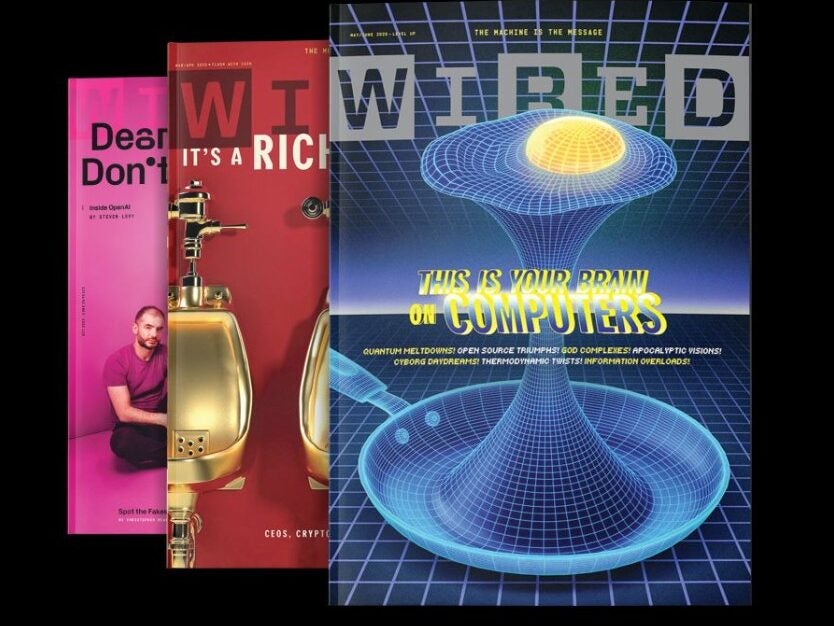
Wired is launching a new forum-style app which lets readers interact with its editorial team.
The app, said to be launching “very soon”, is set to feature forums on which subscribers can interact with Wired journalists about the title’s key coverage areas across tech and politics.
Arielle Goldstein, audience development manager at Wired, said the app will serve as a “community power play” and is one of several ways the brand is aiming to keep readers on its own platforms rather than social media.
She told the Audiencers Festival in London: “We envision that we will have forums on the app where people can come and interact with other Wired readers based on subject matters, and also Wired staff, Wired writers on that same subject matter as well.
“So you might be thinking to yourself, can’t people just go to Reddit for that? The answer is no, because our journalists aren’t hanging out on Reddit. They will be in the app, they will be able to answer your questions in the app, and really drive discussion.”
She added that this means a paid subscription will offer a “rapport with the subject matter expert who you’ve been reading for years, and who you want to continue to build a relationship with”.
The app will be the next stage after Wired revamped its subscription offering in July last year.
Wired now has more than 500,000 paid subscribers, of whom 200,000 signed up in 2025 alone.
Subscription revenue grew by 24% in the US last year.
[Read more: Wired pulls plug on UK print edition as it focuses on global subscriber growth]
The subscription changes included the addition of five weekly subscriber-only newsletters (two were brand new, three were revamped for subscribers), more commenting features, subscriber-only livestream events and, most recently, live events.
The next major launch after the app will be the first Wired World Fair event being held in Miami later this year (and moving outside the US in 2027).
Goldstein said: “The idea behind the fair is that it is supposed to be a futuristic carnival, tickets are for subscribers only, and it will be another great way for our readers to interact with our journalists and to really bring them into the fold, this ecosystem of what it is to be a Wired reader.”
Newsletters are ‘crux’ of new Wired subscription model
She described the newsletters as the “crux of the new subscription model” and said they are designed to build “habitual engagement”.
The newsletters are published on the Wired website for subscribers but they are designed to be read in an email:”It’s supposed to feel conversational, you’re supposed to get the author’s personality, and you’re supposed to feel that rapport with that author that you are receiving a weekly read from.”
Meanwhile, livestreamed online events have shifted from being ad-hoc videos available to all, to regular subscriber-only panels of Wired journalists discussing subjects like electric vehicles and taking audience questions. Goldstein said this is part of a plan to turn “passive readers into active communities”.
She said: “We position our talent as the product. That’s why people come to Wired, because we have experts on the areas that they care most about, whether that’s Silicon Valley news, AI news or politics news.
“And so that is the through-line through all the products that we now offer through our subscription, is that we have our talent front and centre, they are named, recognised faces, and they have a pre-existing relationship with the audience.”
Asked how Wired journalists had got on board with being asked to find the time to do extra things, Goldstein said there had been “a bit of pushback at the start” but “it all starts with one”.
“So one journalist gets on board, and they are having a great experience, and they’re seeing their stats lift, their read time lift, their dwell time lift, because they’re hanging out in the comments, or what have you. That’s going to trickle throughout the newsroom.
“And I think the other element is that we are trying to establish this concept where you are a journalist, yes, but because of that, you’re the subject matter expert, and you have an opportunity to elevate your own personal brand to increase your own discoverability, and I think that is another point that really hooked our journalists.”
Wired moved away from ‘sell cheap at high volume’ subscription model
Alongside the revamped subscription features came a price increase for new subscribers.
A Wired digital subscription currently costs $24 (£18) for the first year and then $48 (£36). This is at least double what a new digital subscriber would have paid one year ago.
Goldstein said the previous price point was “almost insulting” to Wired journalists who were producing the paywalled content.
She said Wired previously followed a “sell cheap at high volume” subscription model but that this led to “high churn and low loyalty”.
“We would see people drop off in high numbers, because they didn’t feel a connection necessarily to the brand, or to the journalists, or to the journalism we were producing.”
She added that a “core tenet of taking stock about what was going wrong for Wired was realising that we were undervaluing our journalism.
“Selling it cheap wasn’t signalling what we wanted it to signal. We say that the pricing was almost insulting, and I know that’s a strong word, but that’s how we felt, and we shifted to reflect the quality of journalism we were producing.”
Goldstein said “we didn’t find that we had a huge churn” after increasing the price.
Of the subscriber growth numbers over the past year, Goldstein added: “We actually found that pricing our content at a level that we feel really reflects our journalism brought in a new wave of readers. They felt that this was content that was worth paying for, as did we.”
The engagement of subscribers is now being measured via a new loyalty metric, which counts a loyal user as someone that returns to Wired at least twice a week.
Wired is also tracking direct traffic as it focuses on “whether or not we’re driving our audiences back to wired.com”, Goldstein said.
She added that the “five-year vision” of Wired is to make sure it is providing what AI cannot.
“There is no avoiding the fact and the truth that AI will be better than any of us at curating your newsfeed. But what AI cannot offer is that authentic human experts, that interaction with curious readers. The only place that you’re going to be able to find that is with the media brand that you love. So, at Wired, we’re… planning to really expand on that over the next several years.”
Wired global editorial director Katie Drummond told Press Gazette earlier this year that creating a “sustainable and growing subscription business is the future of Wired…
“While other components like advertising and commerce play a really important part, I don’t want Wired to be at the whims of anything that I can’t control the way I can control the journalism.”
Last year Wired dropped its UK print edition. The US print edition is now published six times a year. A combined print and digital subscription costs £80 in the UK.
Email pged@pressgazette.co.uk to point out mistakes, provide story tips or send in a letter for publication on our "Letters Page" blog
